



Originally published with WorldCC
By Eric Hall, Chief Executive Officer, LegalSifter
Contracts continue to be the hidden drain on commercial velocity.
Across every buy- and sell-side relationship, contracts continue to be the operating systems for commerce, defining how businesses trade obligations, manage risk, and protect value. Despite the importance, the contracting process continues to be stubbornly inefficient for most organizations. In fact, contract delays and inefficiency are often perceived as the “normal course of business”: delayed redlines, legal department bottlenecks, protracted approvals. But beneath the surface, these challenges create real business impact.
- Procurement: Slower onboarding of suppliers, lost time-sensitive discounts, jeopardized logistics.
- Sales: Delayed deal closings, eroded margins, reduced customer satisfaction.
- Legal: Burnout from low-value reviews, lack of time for strategic risk management.
These hidden costs eat into commercial agility and threaten strategic relationships, on both sides of the trading lifecycle. Companies have gladly embraced the help of AI, but the results have been limited.
The prevailing narrative celebrates speed: faster reviews, fewer bottlenecks, quicker turnaround. But velocity without judgment doesn’t create value—it creates rework, risk, and inconsistency. And in a global contracting environment, inconsistency is a liability.
In addition, as organizations embrace AI co-pilots to accelerate drafting and clause detection, one phase remains stubbornly inefficient: review and redlining. The problem isn’t that AI can’t help—it’s that we’ve asked it to work without the clarity, context, and structure that real productivity requires.
To move beyond surface-level efficiency, we need to rethink AI, not as a substitute for legal or commercial expertise, but as a scalable, structured reflection of essential IP.
The False Promise of Generic AI
Much of today’s enthusiasm for AI in contracts is built on general-purpose generative models trained on public data. These tools are impressive at superficial tasks like summarization or generating “neutral” versions of provisions. But when it comes to the real-world demands of complex commercial negotiations, these tools falter.
When off-the-shelf AI generates vague edits without understanding your business or legal posture, several hidden costs emerge:
- Rework: AI creates language or edits that are not correct for your business, providing the appearance of help, but creating rework for the human editor.
- Variability: Review quality fluctuates between individuals, teams, or regions, leading to inconsistent decisions.
- False Positives: AI flags minor or irrelevant risks, which creates noise and erodes trust in the system.
- Ambiguity: Recommendations without rationale lead to second-guessing and duplicate review cycles.
- Overhead: Reviewers spend more time correcting AI outputs than reviewing the contract itself.
These aren’t theoretical risks; they’re real productivity killers. In today’s environment, where a delay in supplier onboarding or a missed compliance requirement can ripple through the business, inefficiency isn’t a nuisance. It’s a threat.
Contract review isn’t just about words. It’s about judgment. Would you accept this liability clause for a subcontractor in the EU, but not in the US? Does this payment term align with your internal billing cycles or financial controls? Should an IP indemnity be softened or struck altogether based on customer size or industry?
These decisions should be grounded in your playbooks, standard positions, and documented rationale—not a generic model’s assumptions about risk. And when generative AI suggests edits without rationale—or worse, ones that conflict with your internal norms—it doesn’t streamline review. It sets it back.
Despite rapid hype cycles, most contract AI adoption today remains limited to narrow tasks like clause detection or data tagging. As WorldCC’s AI in Contracting research confirms, few organizations have successfully scaled AI into judgment-heavy areas like redlining or negotiation—largely due to fragmented processes and inconsistent playbooks.
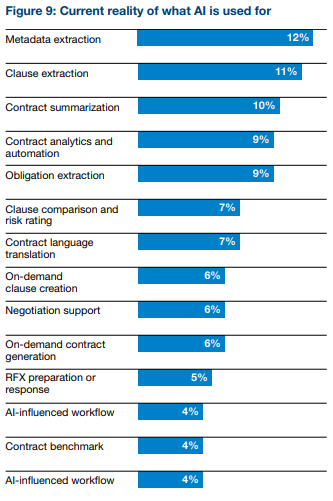
To move from hype to high-impact, organizations need a clear blueprint for AI driven contract review—one grounded not in speed alone, but in structure, quality, and repeatable judgment. True productivity means consistently making better decisions, faster.
Four Essentials for Real Contract Productivity
- Oversight: Contract reviews must follow your organization's guidelines, not guess at them.
- Uniformity: Every evaluator, region, and business unit should apply the same logic and standards.
- Precision: Human quality edits and prioritized risk identification, reducing noise and rework.
- Transparency: Every edit must be linked to a playbook provision, fostering confidence and accountability.
Real-World Impact
For example, a Fortune 500 logistics company implemented LegalSifter ReviewPro™ to streamline its global procurement contract reviews. Within 90 days, they cut average cycle time by 27%, eliminated redundant reviews across regions, and standardized preferred term usage—freeing legal and sourcing teams to focus on strategic negotiation rather than rework.
Rethinking Productivity in Legal and Commercial Review
To unlock contract productivity across the full lifecycle, organizations must move beyond generic tools and focus on contract specific AI capabilities—ones that reflect their standards and make expert judgment repeatable.
At its core, true productivity in contract review means:
- Fewer redundant review loops
- Uniform application of legal and business guidelines
- Decisions grounded in traceable reasoning
- Speed that doesn’t compromise control
True contract productivity addresses these requirements head-on. It turns your legal and commercial teams into accelerators of trust, speed, and scale.
The goal isn’t to automate everything. It’s to ensure the right people are spending time on the right work, enabled by technology that respects and scales their expertise.
As WorldCC notes, AI is only as effective as the framework it supports. Without defined playbooks and structured rationale, even the most powerful AI models introduce more noise than clarity. True productivity emerges when contracting organizations prioritize alignment, judgment, and traceability, and then apply AI to scale that system, not replace it.
Your Organizational Knowledge Is the True Engine
The most valuable asset in your contract process isn’t the AI—it’s the institutional knowledge your teams already possess: preferred clause wording, standard positions, contingency strategies, and deal history insights. These are the unwritten rules that drive effective contracting.
The problem? That expertise is often fragmented—stored in emails, spreadsheets, or locked in individual memory. When teams grow, restructure, or expand globally, this fragmentation leads to inconsistent outcomes, longer negotiations, and reduced confidence.
Generic AI cannot ingest unstructured human wisdom. And without structure, AI only amplifies inconsistency.
The solution is to codify your knowledge: transform contract playbooks, negotiation rationales, and standard clauses into structured, accessible guidance embedded into the review process. This doesn’t just streamline contracts. It standardizes judgment.
From Reviewers to Designers: Elevating Your Team’s Role
To build a productive contract review system, organizations must empower their legal and commercial professionals to evolve from reactive reviewers into framework designers.
That shift begins with three foundational steps:
- Organize Before You Automate
Before applying AI, ensure your guidelines, playbooks, and review logic are codified and accessible. Otherwise, you’re automating inconsistency.
- Reflect, Don’t Invent
AI should mirror your internal thinking, not improvise. It should explain its edits, cite your rationale, and defer when rules are ambiguous.
- Enable Reviewers to Build Systems
Equip your professionals to refine the frameworks behind the technology. When they control the logic, trust and productivity rise.
This mindset doesn’t replace legal insight—it amplifies it, ensuring your contracts reflect strategic intent, not just legal correctness.
As WorldCC advocates, better contracts lead to better business. That starts by empowering reviewers to work with consistency, clarity, and context.
Delivering Productivity You Can Trust: LegalSifter ReviewPro™
At LegalSifter, we’ve spent over a decade building AI that supports, not supplants, contract reviewers.
LegalSifter ReviewPro™ merges contract-specific AI with your internal guidelines, standard positions, and rationale to deliver policy-aligned redlines directly in Microsoft Word. It flags only what matters, suggests structured improvements, and always explains why—ensuring confidence and consistency across teams, geographies, and partners.
It’s designed to put the four essentials of real contract productivity—oversight, uniformity, precision, and transparency—into action, so that contract reviews are faster, smarter, and fully aligned with your standards from day one.
ReviewPro comes with prebuilt playbooks, so you can begin reviewing contracts with confidence from day one. As your needs evolve, you can tailor and expand those playbooks to reflect your organization’s specific preferences, standards, and risk posture.
This isn’t just AI for AI’s sake. It’s AI built to reflect your way of doing business.
By transforming unstructured know-how into structured guidance, and embedding it into the review process, ReviewPro enables faster, smarter, and more defensible contracting at scale.
What Real Contract Productivity Looks Like
In the end, true productivity is not about working faster. It’s about:
- Reducing rework and back-and-forth
- Ensuring decisions are replicable across teams
- Accelerating the right deals without compromising control
- Strengthening the trust and consistency at the heart of trading relationships
With the right structure, AI becomes a multiplier; not a mess. ReviewPro helps contracting professionals stop firefighting and start building scalable, intelligent systems that move deals forward and strengthen relationships.
Because when AI reflects your expertise—not replaces it—contracts become not just faster, but better.
About Eric Hall
Eric is the CEO of LegalSifter, a Harvard-trained lawyer, and technology executive with over 20 years of experience in enterprise SaaS. He previously led Adobe’s $5B+ Digital Experience business as CMO and served as SVP/GM of Professional Services and Customer Success. At LegalSifter, Eric merges legal insight with operational strategy to build scalable, AI-powered infrastructure for contract operations.