Contract lifecycle management (CLM) is often evaluated through features such as workflow automation, dashboards, search, and integrations. These capabilities matter. However, long-term success in CLM is not determined by features alone. It is determined by structure—specifically, how contracts are organized once they enter the system.
That structural choice becomes increasingly important as contract volume grows across departments and stakeholders. As organizations expand, contract relationships become more layered, more interconnected, and more operationally significant. This is where contract binders play a critical role.
A contract binder is a relationship-centered structure in contract lifecycle management that organizes all agreements governing a commercial relationship into a single unified record.
From that foundation, visibility improves, version control becomes coordinated, and reporting aligns with the governing reality of the relationship.
Key Takeaways
- Contract binders organize agreements around commercial relationships, not individual documents.
- A relationship-centered CLM structure improves visibility and version control.
- Scalable contract lifecycle management depends on architectural clarity.
Contracts Operate as Relationships, Not Files
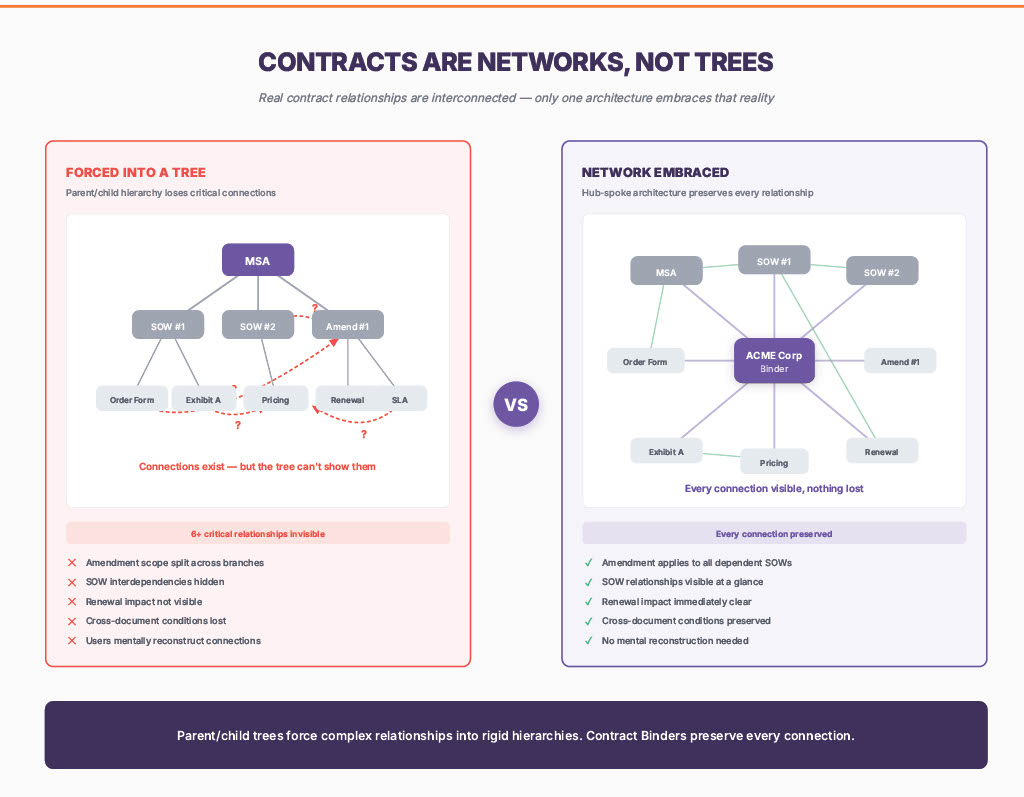
Contracts rarely function as standalone documents. A single customer relationship may include a master agreement, multiple statements of work, amendments, pricing updates, renewals, and addenda. Vendor relationships often evolve in similar ways over time.
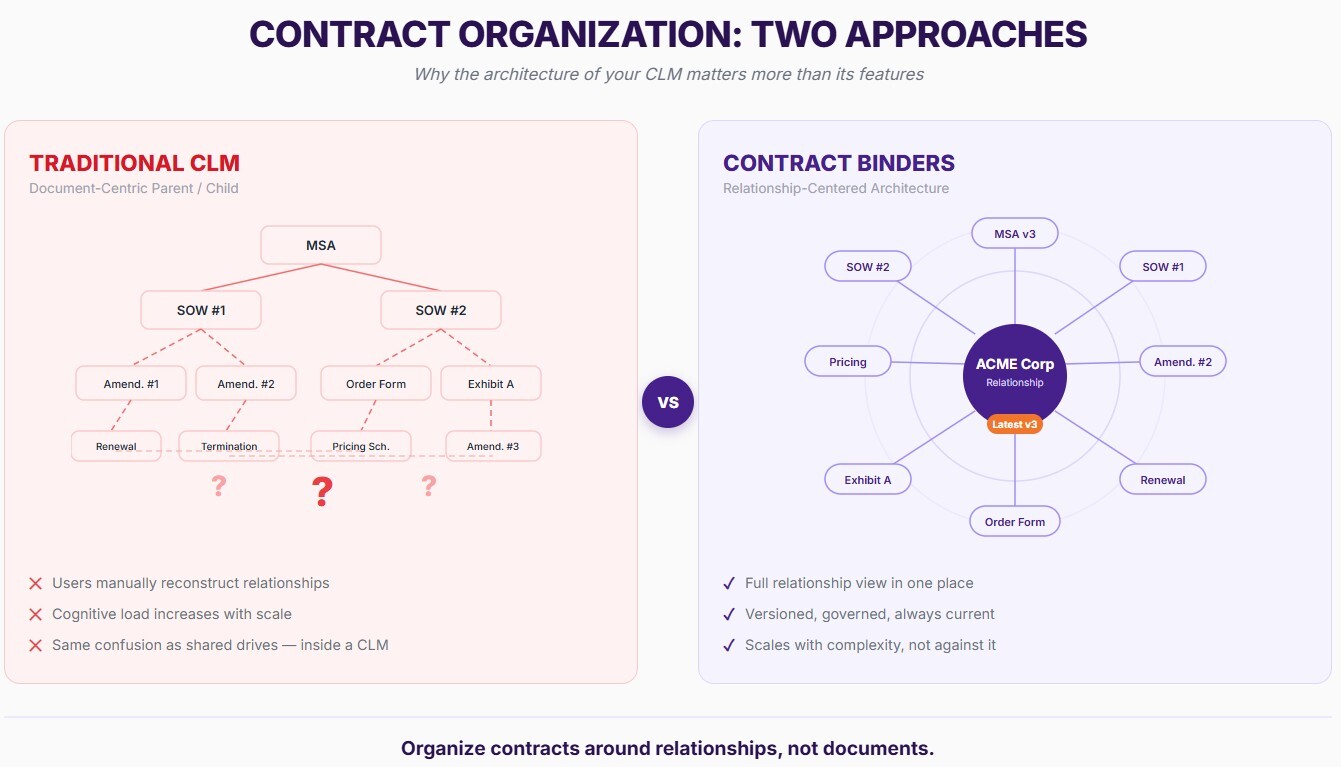
Taken together, these documents define a single commercial relationship. Yet many CLM systems store them as separate records, linked together but not structurally unified. When procurement, legal operations, finance, or sales operations teams need to determine what governs the relationship, they must navigate across multiple files to reconstruct the full picture.
That approach may be manageable at low volume. As complexity increases, however, it becomes inefficient and introduces unnecessary risk.
What Is a Contract Binder?
While many CLM systems organize agreements as individual records linked together through hierarchies or references, a contract binder organizes them around the commercial relationship itself.
Within a binder, all agreements that define a relationship (master agreements, amendments, SOWs, schedules, and renewals) exist as components of one governing framework. The structure reflects how the relationship operates in practice rather than how documents are stored.
If it governs the relationship, it belongs in the binder.
By aligning system design with commercial reality, contract binders reduce ambiguity and make it easier for stakeholders to understand what controls without reconstructing context across multiple records.
Why Structure Impacts Cross-Functional Visibility
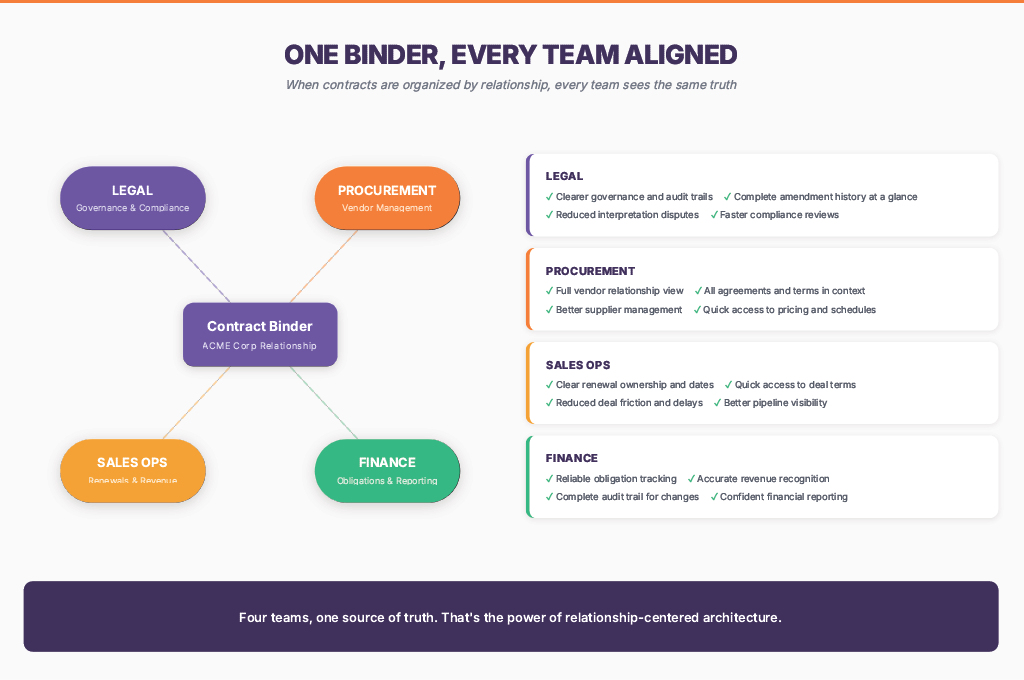
CLM systems are used by more than legal teams. Procurement requires visibility into vendor commitments. Sales operations needs clarity on active customer terms. Finance relies on accurate contract data for reporting and forecasting. Compliance teams monitor obligations and renewals.
When related contracts are scattered across disconnected records, each team may interpret the relationship differently. Inconsistency in understanding can lead to reporting discrepancies, missed obligations, or delayed decisions.
A binder-based structure reduces that fragmentation by presenting the governing framework in one place. Version control becomes clearer. Reporting aligns with active terms. Oversight becomes easier to maintain across functions. In this way, architecture supports coordination rather than complicating it.
Version Control Without Reconstruction
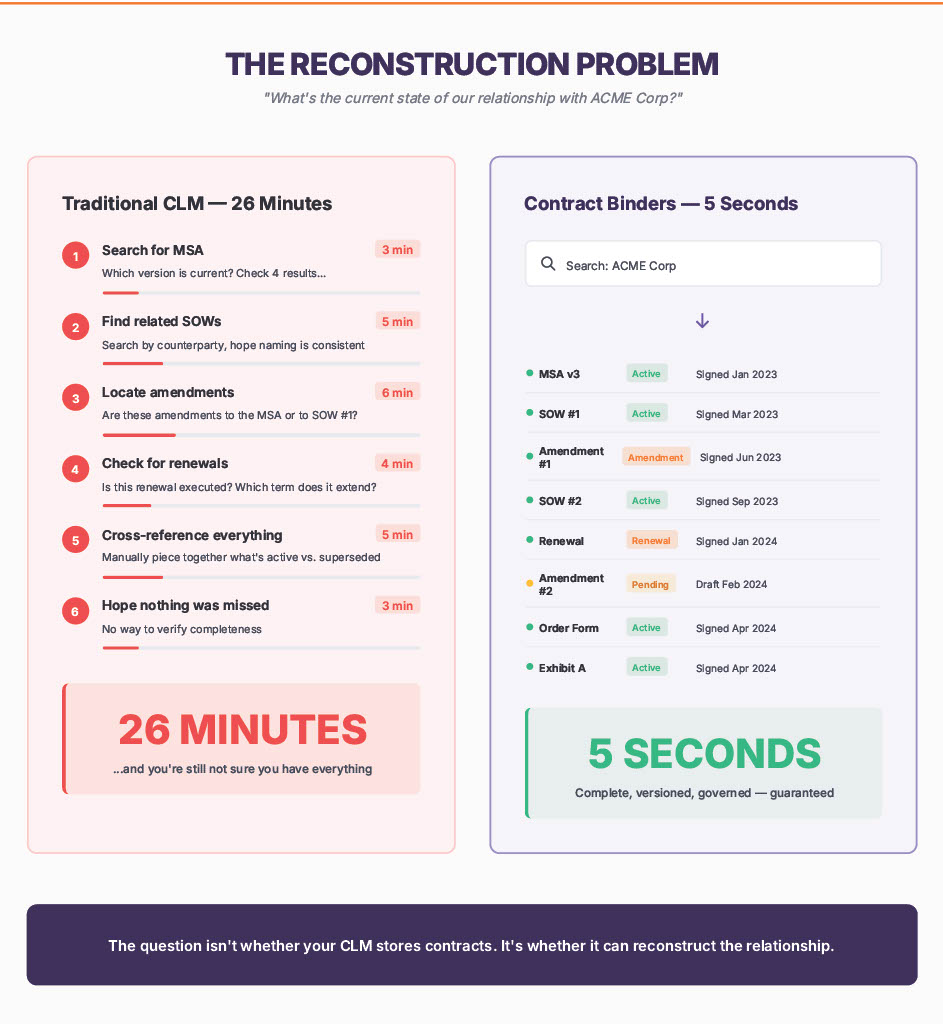
One of the most common operational pain points in contract management is determining which version of an agreement is currently in force. Amendments modify prior terms. Renewals extend timelines. Pricing schedules evolve.
In document-centric systems, users often piece this together manually. A binder-based structure, by contrast, reflects the current governing state within the relationship record while preserving historical versions for reference. The system itself maintains structural clarity, reducing reliance on institutional memory and minimizing interpretive error.
For contract managers and operations teams, this clarity directly translates into reduced risk.
Designed for Growing Organizations
Contract complexity is not limited to large enterprises. Any organization that is expanding its customer base, increasing vendor relationships, or layering agreements over time can experience structural strain within its CLM system.
Contract binders provide a scalable contract lifecycle management framework because they align system design with commercial reality. As relationships evolve, the structure remains coherent. Rather than adding more links and cross-references, the system maintains a unified governing record that grows with the business.
That alignment makes growth manageable instead of disruptive.
How LegalSifter’s Contract Logix CLM Applies This Model
LegalSifter’s Contract Logix CLM platform is built around a contract binder architecture. By organizing agreements around the commercial relationship they govern, Contract Logix enables cross-functional visibility, embeds coordinated version control within a single structured record, and aligns reporting with active governing terms. As contract portfolios expand, the structure remains intact, supporting oversight without multiplying complexity.
For organizations investing in contract lifecycle management, the question is not only what the system can automate. It is how the system structures the relationships that drive the business. In CLM, architecture determines whether coordination improves or complexity compounds.
Request a demo of Contract Logix to see how a relationship-centered contract lifecycle management architecture strengthens visibility, version control, and governance across your contract portfolio.