



Contracts define relationships, obligations, and expectations across every area of business. As contract volume and complexity increase, traditional review and negotiation processes can no longer keep up. AI-assisted contracting solves this problem by using artificial intelligence to make each step faster, more accurate, and easier to manage.
AI-assisted contracting applies intelligent tools to authoring, review, negotiation, and obligation management throughout the contract lifecycle. The technology highlights issues, proposes edits, and ensures consistency using structured guidance and contract playbooks. One key capability is AI contract review, which helps legal and business teams detect risk and align language with company standards.
Quick Takeaways
- AI-assisted contracting combines automation and legal expertise to improve speed and accuracy.
- AI contract review identifies risk, applies guidance, and accelerates approvals.
- Playbooks translate company policy into consistent review instructions.
- Human oversight ensures accountability and trust.
- As contract volume grows, AI-assisted contracting helps organizations manage work more efficiently.
👉 Use the Budget Justification Checklist for Legal AI to evaluate costs, ROI, and readiness before you invest.
Why AI-Assisted Contracting Matters
Organizations depend on timely contract execution to move business forward. When review cycles stall, revenue slows and risk exposure increases. AI-assisted contracting helps prevent these challenges through measurable gains in speed, quality, and consistency.
- Speed at Scale: AI can review contracts in minutes instead of hours. Advanced tools now perform automated redlines directly in Word, helping users process agreements faster.
- Consistency in Standards: AI systems guided by playbooks maintain consistent language and enforce company policies across every contract. This minimizes variation in risk tolerance and drafting style between reviewers.
- Risk Mitigation and Quality: AI tools identify missing clauses, vague wording, and deviations from approved terms. This approach improves review quality while reducing exposure to errors.
- Reduced Legal Bottlenecks and Cost: With repetitive tasks handled by AI, legal and procurement teams can focus on higher-value analysis and strategy, reducing reliance on outside counsel.
- Institutional Knowledge Retention: Playbooks supported by AI preserve organizational knowledge and ensure all reviewers follow established guidelines without extensive training or expertise.
- Operational Efficiency: Streamlined reviews shorten cycle times and keep deals moving. Faster approvals mean improved productivity and better collaboration across teams.
AI-Assisted Contracting: Key Components
1. Contract-Specific AI Models
Modern AI-assisted contracting tools often rely on models trained specifically for legal contracts. These models analyze contract language to identify clauses, obligations, risks, or missing provisions.
For example, LegalSifter’s “Sifters” are targeted AI models trained to recognize concepts, clauses, risks, obligations, and missing language across contract types. Each Sifter detects clauses, gaps, and deviations to guide users toward appropriate actions.
2. Structured Playbooks
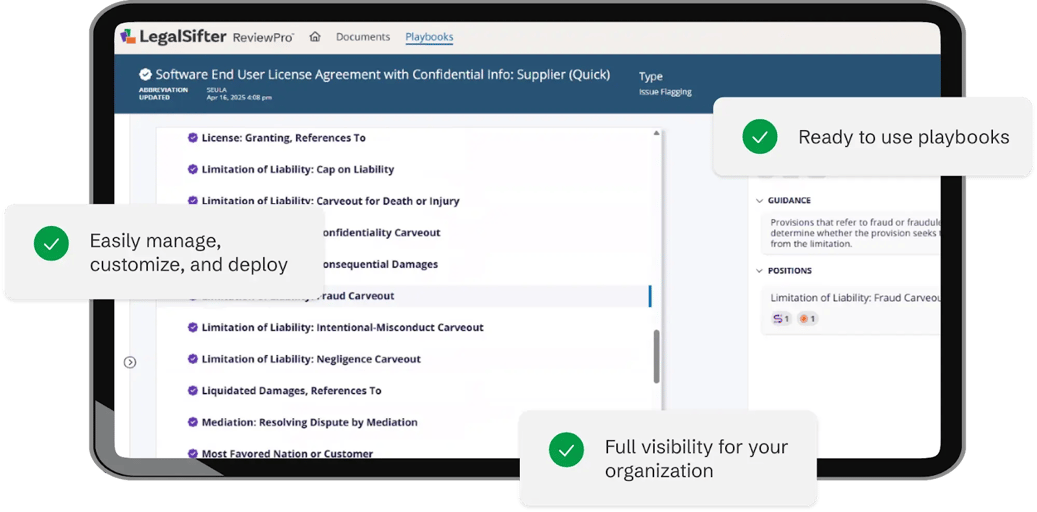
Playbooks define how AI interprets findings. They outline which clauses are acceptable, which need edits, and how to respond to potential risks. A clear playbook ensures AI recommendations align with business rules and legal standards.
3. Automated Redlining
Once the AI identifies areas of concern, it can typically propose edits directly in the contract, often as redlines or comments in Word or other standard formats. This enables a faster, more systematic first pass. For instance, ReviewPro applies redlines based on the playbook guidance, giving teams a marked-up draft ready for negotiation.
4. Human Oversight
AI serves as an assistant or first pass, not a substitute for human judgment. Experienced legal or business reviewers must evaluate AI-flagged issues, assess context, negotiate terms, and apply discretion. This human/AI collaboration is widely recognized as best practice for responsible contract review.
5. Integration with Contract Management Tools
Integrating AI contract review with contract lifecycle management or repository tools enhances visibility across the entire workflow. AI output, such as flagged issues, missing clauses, or extracted terms, can be routed into existing systems for clause tracking, reporting, and ongoing monitoring after signature.
6. Continuous Feedback
Because contracts and risk tolerances evolve over time, the best AI-assisted contracting implementations include feedback loops. Legal and business teams review AI suggestions, provide corrections when needed, and help retrain models. Over time, this improves accuracy, reduces false positives/negatives, and aligns the AI more tightly with internal standards.
Use Cases Across Industries and Job Functions
AI-assisted contracting benefits a wide range of sectors and teams:
- Procurement: Streamlines supplier agreements and vendor onboarding.
- Sales: Accelerates customer contract approvals without waiting on legal.
- Finance: Reviews payment terms, guarantees, and indemnities efficiently.
- Healthcare and Life Sciences: Ensures regulatory clauses and data provisions are properly managed.
- Manufacturing: Handles supply chain contracts and compliance documentation.
- Technology and SaaS: Reviews service level agreements and data protection clauses quickly.
These use cases demonstrate how automation supports consistency and scalability across high-volume business functions.
Benefits in Detail
|
Benefit |
Description |
|
Faster Turnaround |
AI reduces review time from hours to minutes. |
|
Lower Costs |
Makes better use of resources by reducing time spent on repetitive tasks. |
|
Accuracy |
Flags missing or inconsistent terms before approval. |
|
Standardization |
Keeps contract language uniform across departments. |
|
Scalability |
Handles higher contract volume with existing staff. |
|
Visibility |
Extracts key data for reporting and compliance tracking. |
|
Collaboration |
Makes it easier for non-legal teams to participate in review. |
Best Practices for Adoption
1. Build Trust Through Transparency
Show users how AI reaches its conclusions. Each recommendation should link to specific playbook guidance to maintain confidence and accountability.
2. Start Simple
Begin with low-risk contract types such as NDAs and vendor agreements. Expand gradually as teams gain familiarity and feedback improves accuracy.
3. Maintain Strong Data Governance
Ensure all AI systems follow security, privacy, and encryption requirements. Contracts often contain sensitive or confidential data.
4. Keep Playbooks Updated
Regularly review and refine playbooks to ensure they reflect current regulations and business policies.
5. Monitor and Measure Performance
Track metrics like review time, override rate, and accuracy to evaluate effectiveness. Continuous measurement helps teams refine processes and identify training needs.
When organizations follow these best practices, they achieve faster reviews, greater visibility, and stronger data accuracy across their portfolios.
AI-Assisted Contracting: What’s Driving Change
Rising Volume and Shrinking Bandwidth
Contract portfolios continue to expand across industries. Yet legal departments face limited resources and tighter budgets. Manual review processes can’t keep up with the pace of business, causing bottlenecks and missed opportunities.
Compliance and Risk Pressures
As regulations become more complex, organizations must ensure every agreement meets policy and legal requirements. AI-assisted contracting is gaining momentum, helping teams maintain visibility and consistency without increasing headcount.
A Practical Path to Adoption
Teams often begin by applying AI to standard agreements such as NDAs, vendor forms, or simple service contracts. Early pilots build trust and help refine playbooks. From there, integrating AI output into existing repositories or lifecycle systems makes it easier to track results and measure ROI.
The Technology Behind the Shift
Modern AI tools combine clause detection, structured guidance, and generative suggestions to accelerate redlining while keeping human oversight intact. This blend of automation and expertise delivers speed and accuracy without sacrificing judgment.
What Comes Next
AI in contracting continues to advance, with new agentic and AI agent models focused on improving usability, transparency, and oversight. Emerging approaches aim to make recommendations more context-aware and better aligned with business goals, while explainable AI techniques will help users understand why certain risks or terms are flagged. At the same time, evolving governance and compliance standards will strengthen the security and accountability of AI-assisted review.
Put AI-Assisted Contracting Into Practice
AI-assisted contracting transforms how legal and business teams handle agreements. By pairing automation with structured playbooks and human oversight, organizations can simplify complex review cycles, improve accuracy, and keep every contract aligned with policy and compliance goals.
LegalSifter’s AI-powered solutions help teams work smarter by combining targeted clause detection, guided recommendations, and reliable workflow integration.
Ready to see how AI-assisted contracting can improve your review process? Schedule a demo with LegalSifter to explore how our technology supports efficient, consistent, and defensible contract management.