Limitation of Liability Clause Risk: How AI Review Helps

Limitation of Liability Clause Risk: How AI Review Helps

By Buddy Broussard, LegalSifter

Most commercial contracts begin with familiar business terms: what will be delivered, what it will cost, and when performance is due. But when negotiations become difficult, they rarely stall over scope or timing. They stall over risk.

That’s why the limitation of liability clause is one of the most negotiated and most consequential provisions in modern contracting. Few provisions shape contract exposure more directly than limitation of liability. At its core, this clause answers a simple question: What is the maximum financial downside if the deal goes wrong?

World Commerce & Contracting’s annual Most Negotiated Terms research consistently ranks limitation of liability among the most heavily negotiated provisions in commercial agreements, reflecting how central this clause is to risk allocation.


Read more

Force Majeure Clause Risk & How AI Contract Review Helps

Force Majeure Clause Risk & How AI Contract Review Helps

By Buddy Broussard, LegalSifter

Every contract is written for the world as it’s expected to be. Force majeure is the clause that governs the world as it sometimes becomes.

But contracting professionals know that real-world operations rarely stay predictable forever. Supply chains break down. Weather events disrupt delivery. Governments impose restrictions. Markets shift overnight.

That’s why the force majeure clause remains one of the most important and most carefully negotiated provisions in modern contracting. World Commerce & Contracting’s annual Most Negotiated Terms research consistently finds that risk allocation provisions dominate negotiation priorities, underscoring how much time organizations spend negotiating contract language that will only apply when performance breaks down.

Force majeure provisions gained renewed prominence after COVID-era disruptions, but they have always played a critical role in defining contractual resilience: what happens when performance becomes impossible due to events outside either party’s control.

Read more

Warranty Clause Risk (& How AI Contract Review Helps)

Warranty Clause Risk (& How AI Contract Review Helps)

By Buddy Broussard, LegalSifter

Most commercial contracts are built around performance: what will be delivered, when it will be delivered, and what the parties expect from the relationship. But expectations alone do not create enforceable protection.

That’s why the warranty clause remains one of the most important and most frequently negotiated provisions in modern contracting.

Warranty language defines what one party is actually committing to deliver, and what the other party can reasonably rely on. Disputes often arise when warranties are drafted too broadly or remedies are unclear.

A promise without a remedy creates uncertainty. A remedy without limits creates risk.

Read more

The Accidental Contract Manager: A Guide to Scaling a Nonprofit

The Accidental Contract Manager: A Guide to Scaling a Nonprofit

By Matt Darling, LegalSifter

You didn’t get into the nonprofit world because you have a burning passion for “Limitation of Liability” clauses or “Indemnification” provisions. But as organizations grow, nonprofit contract management quickly becomes an unavoidable part of running a successful mission-driven organization. 

Read more

AI Contract Redlining Guide | First-Pass Automation With Human Oversight

AI Contract Redlining Guide | First-Pass Automation With Human Oversight

redlining-heroA New Model, Built for Real-World Legal Workflows

The rise of generative AI has made it easier than ever to suggest contract edits, but harder to know which ones to trust. Many tools offer flashy demos or conversational interfaces, but lack the rigor, control, and legal reliability that professionals demand.

LegalSifter ReviewPro™ is the result of more than 10 years spent building and honing contract-specific AI. Long before the rise of generative AI, we applied natural language processing (NLP) to contracts, training models to understand risk, compliance, and negotiation context with legal-grade precision.

At the heart of ReviewPro is our proprietary AI Sifter Engine®, a system of more than 2,200 high-accuracy Sifters, each designed to detect nuanced legal concepts across a wide range of agreements. Trained on thousands of real-world contracts and continually refined by legal experts, these Sifters provide a deep, battle-tested foundation of domain intelligence.

Now, we’ve paired that foundation with the power of large language models, within a controlled, auditable framework. The result is ReviewPro: a platform that combines the precision of expert-coded rules with the fluency and flexibility of generative AI. It acts as a true first-pass reviewer, automating the routine while keeping professionals in charge.

This guide outlines:

Read more

Beyond Cycle Time: Measuring Commercial Impact

Beyond Cycle Time: Measuring Commercial Impact

By Matt Darling, LegalSifter

Everyone obsesses over cycle time.

How fast did legal turn that NDA? How many days to get that new business contract signed? It’s the metric that gets reported in every quarterly business review, the number that sales leaders focus on, and the benchmark that determines whether your legal ops team gets a pat on the back or put under the microscope.

Read more

cro-post-03

The CRO’s Guide to Closing Deals Faster (Without Increasing Risk)

The CRO’s Guide to Closing Deals Faster (Without Increasing Risk)

By Matt Darling, LegalSifter

cro-post-01

You know what kills deals? Time.

Not price objections. Not competitor pressure. Not even budget freezes. It’s the slow, agonizing crawl through contract review that turns hot opportunities into cold losses.

Read more

The 7 Contract Clauses That Cause the Most Business Risk (and How AI Review Helps)

The 7 Contract Clauses That Cause the Most Business Risk (and How AI Review Helps)

By Buddy Broussard, LegalSifter

Most experienced business leaders are comfortable reviewing and negotiating familiar deal terms in their commercial contracts: scope of work, pricing, delivery timelines, renewal periods. But negotiations rarely stall over those points.

Read more

Contract Operations OKRs: How to Align Objectives and Results

Contract Operations OKRs: How to Align Objectives and Results

For years, key performance indicators (KPIs) have been the standard for measuring contract performance. They track numbers like cycle time, approval rates, and renewals, but they often stop there, providing information without direction. As businesses demand greater accountability and alignment across legal, procurement, and finance, many are replacing KPIs with contract operations OKRs, or objectives and key results.

Read more

How to Choose the Best Healthcare Contract Management Software

How to Choose the Best Healthcare Contract Management Software

Managing contracts in healthcare requires precision, compliance, and efficiency. Every agreement, from physician employment contracts to business associate agreements, carries strict regulatory requirements and financial implications. Without the right system in place, teams can lose valuable time searching for documents, miss renewal deadlines, or expose their organization to unnecessary risk.

Read more

6 Common Mistakes in AI Contract Review and How to Avoid Them

6 Common Mistakes in AI Contract Review and How to Avoid Them

AI contract review tools are revolutionizing how legal and business teams identify risk, accelerate workflows, and uncover hidden value in their agreements. Instead of combing through dense legal language manually, AI can extract key terms, identify missing clauses, and surface important details across hundreds of contracts in minutes.

Read more

AI Agents vs. Agentic AI: What Legal Teams Need to Know

AI Agents vs. Agentic AI: What Legal Teams Need to Know

By Lars Mahler, LegalSifter

“Agentic AI” is everywhere—analyst maps, vendor decks, buzzy demos. For many legal use cases, however, autonomous AI isn’t necessarily beneficial; it can create compliance gaps, liability, and missed opportunities. This article explains the difference between AI agents (user‑directed helpers) and agentic AI (autonomous agents that control their own work), and why LegalSifter recommends orchestrated, multi‑agent workflows—not agentic autonomy.

Read more

Demystifying AI for Contract Review: A Procurement Leader’s Guide

Demystifying AI for Contract Review: A Procurement Leader’s Guide

Is your contract review process built for speed, or stuck in first gear? Are you being asked to “do more with less” while reviewing third-party vendor contracts and supplier agreements at scale? Can AI contract review actually help… or is it just another overhyped buzzword?

Read more

5 Reasons ChatGPT Shouldn’t Be Used for Contract Review (If Consistency Matters to You)

5 Reasons ChatGPT Shouldn’t Be Used for Contract Review (If Consistency Matters to You)

By Lars Mahler + Buddy Broussard, LegalSifter

As generative AI becomes more accessible and widely adopted, it might be tempting to assume that a tool like ChatGPT can replace more specialized solutions. After all, it can draft, summarize, and translate language quickly and convincingly.

Read more

AI for Contract Review: Top Benefits for Speed, Accuracy & Cost

AI for Contract Review: Top Benefits for Speed, Accuracy & Cost

Contract review takes time. For many legal, procurement, and finance teams, that time adds up, slowing down deals, increasing legal spend, and introducing avoidable risk. Manual reviews often miss key details or lead to inconsistent decisions, especially when different people handle similar agreements.

Read more

“Put My Brain in a Box”: The Real-World Contract Challenges Teams Shared at ISM World 2025

“Put My Brain in a Box”: The Real-World Contract Challenges Teams Shared at ISM World 2025

By Tom Henson, SVP of Product Management & Marketing, LegalSifter

The Institute for Supply Management (ISM) 2025 conference was, in a word, energizing. As professionals across procurement, supply chain, and operations came together, a surprising and consistent theme emerged: contract review is still a major bottleneck, particularly in complex industries like healthcare, energy, and logistics. At LegalSifter, we had the chance to talk with dozens of professionals who were candid about their pain points and priorities. Their stories illuminated the growing gap between what traditional contract lifecycle management (CLM) systems offer and what business leaders, supply chain and procurement professionals, and their legal teams actually need.

Read more

Building Better Contract Playbooks: A Practical Guide for Operational Success

Building Better Contract Playbooks: A Practical Guide for Operational Success

By Buddy Broussard, LegalSifter

If you’ve spent enough time negotiating contracts, you know the feeling: déjà vu over the same terms, last-minute escalations, misaligned expectations. The question isn’t whether your organization needs a contract playbook, it’s why you haven’t built or refreshed one yet.

Read more

The 4 Cornerstones of Effective Contract Operations

The 4 Cornerstones of Effective Contract Operations

In contract operations, achieving excellence requires an approach that integrates tools, processes, and—most importantly—people and expertise. While technology solutions like Contract Lifecycle Management (CLM) software play a critical role in streamlining contract operations, they are not sufficient on their own. The foundation of effective contract operations is built on four key cornerstones: Negotiation Playbooks, Document & Data Management, Change Management, and CLM Administration. Here, we explore these cornerstones and gain an understanding of why a human-in-the-loop with contract expertise is absolutely necessary for successful contract operations. 

Read more

featured

7 Essential Elements of A Contract

7 Essential Elements of A Contract

Know the essential elements of a contract for it to be legally binding. If one or more of these elements are missing, the contract may be void or unenforceable.

Read more

“Efforts” + “Endeavor” = WTF.

“Efforts” + “Endeavor” = WTF.

b29c97_30d230260a05438a91748ff695bb325e~mv2

I’ve seen more than my fair share of unfortunate drafting, but my work for LegalSifter has exposed me to a whole new level of stoopid.

Read more

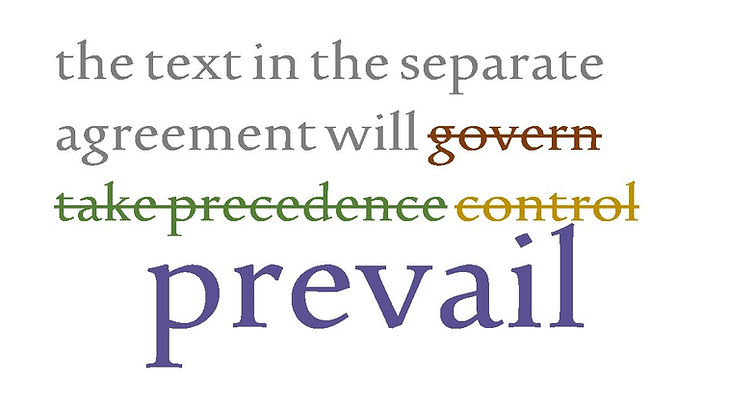
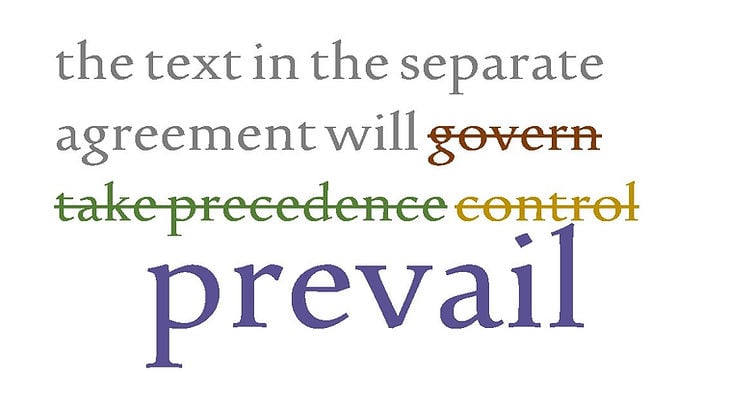
“Control,” “Prevail,” “Take Precedence,” or “Govern”?

“Control,” “Prevail,” “Take Precedence,” or “Govern”?

b29c97_a045a527598c418f843cf1bbf8d3cae2~mv2

Ken Adams here. This is from this post on my blog. In contract drafting, sometimes choosing one word or phrase over various alternatives involves fiendish subtlety. Other times…not. The post below falls into the latter category. But even if not a whole lot is at stake, you have to make a choice, so it might as well be a halfway principled one. 

Read more